
Retail media · 9 min read
What Is Retail Media Advertising? Formats and Measurement
Retail media is advertising sold by retailers using first-party shopper data, on their own sites, off-site and in store. Formats, networks, closed-loop measurement and why comparing results across retailers is hard.
By The Vexio team Published Updated
What is retail media advertising?
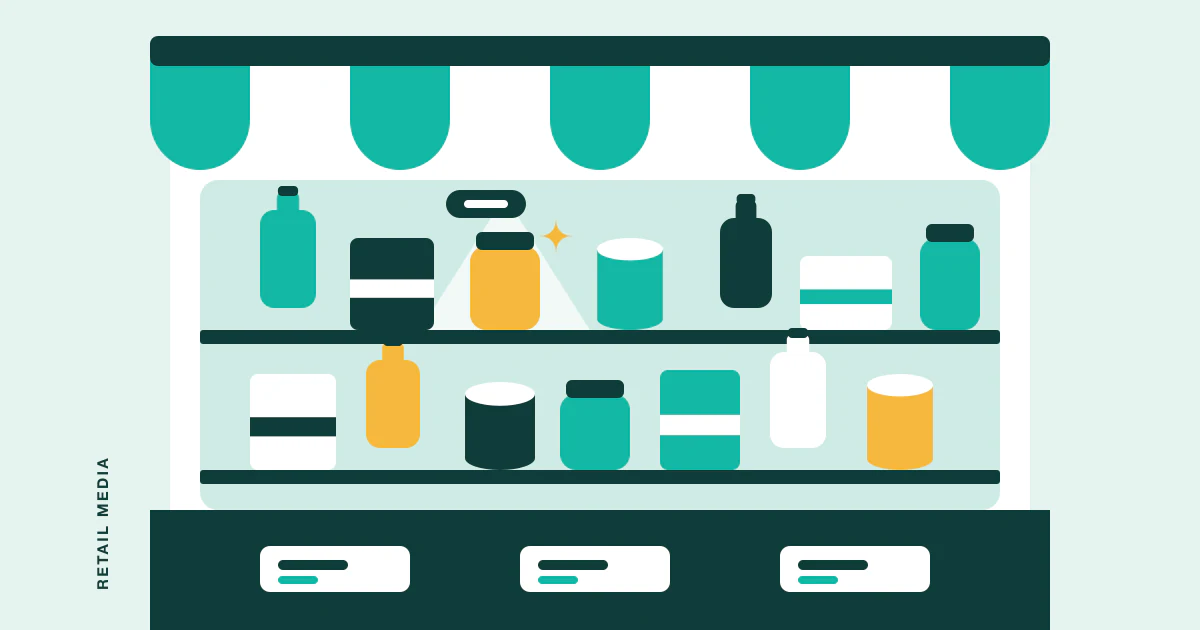
Retail media advertising is advertising sold by a retailer, using the retailer’s own shopper and sales data to target and measure campaigns. The ads can run on the retailer’s website and app (on-site), on other publishers and platforms (off-site), and in physical stores. Brands pay to reach people who are shopping, or have shopped, with that retailer.
IAB Europe’s May 2026 pan-European definition says commerce media networks, which include retail media networks, let brands address shoppers throughout their buying journey, on and off owned platforms, using commerce and retail data for planning, execution and measurement. The IAB and Media Rating Council (MRC) measurement guidelines frame retail media as marketing to consumers near their point of purchase or their choice between brands or products. The sections below cover the environments, formats, networks and the measurement problems that make cross-retailer reporting hard.
On-site, off-site and in-store retail media
IAB Europe splits retail media into three environments. The labels follow its May 2026 definitions, checked on 2026-10-14.
| Environment | Where ads run | Formats IAB Europe names |
|---|---|---|
| On-site | The retailer’s own websites and apps | Sponsored Products, Sponsored Display, display and video units |
| Off-site | Third-party inventory outside the retailer’s properties, targeted with the retailer’s first-party data | Display, video, social, connected TV, digital out-of-home, digital audio, generative AI chat platforms |
| In-store | Physical stores, through digital or static touchpoints | Digital screens (video, display, audio, smart TVs), print and physical activations |
On-site
On-site is where retail media started. The ad appears while a shopper browses or searches on the retailer’s property, close to the point of purchase, and the retailer’s first-party data (what shoppers search, view and buy) drives targeting.
Off-site
Off-site overlays the retailer’s data on third-party inventory, to target audiences and to provide measurement beyond the retailer’s own platform. It involves more parties: the publisher, an ad server, often a demand-side platform and the retailer. Each can report its own numbers.
In-store
In-store digital retail media places ads in physical retail environments and uses retailer data for planning, targeting and measurement. The IAB/MRC guidelines include a chapter on in-store environments, so the industry treats it as part of the same discipline.
Retail media ad formats
Names vary by network, but a few formats cover most on-site buying.
Sponsored products. Ads for individual product listings. Amazon describes Sponsored Products as cost-per-click ads that appear in shopping results and on product detail pages. Walmart Connect groups Sponsored Products, Sponsored Brands and Sponsored Videos under “Sponsored Search”.
Sponsored brands. Ads that carry a brand logo, a custom headline and several products. Amazon says Sponsored Brands supports cost per click and cost per thousand viewable impressions.
Display and video. Banner and video placements on the retailer’s site and app. Walmart Connect lists Onsite Display. Amazon’s Sponsored Display page, checked on 2026-10-14, says the product is now called display ads and is created under Display, Video and Audio campaigns in Amazon Ads Agent.
Everything else. Networks also sell connected TV, audio, email and push notifications, programmatic access, social and influencer activations, shelf and in-store placements. Which ones a network offers changes, so read its own site.
Retail media networks by their own description
These descriptions come from each network’s public pages, checked on 2026-10-14. They are not a ranking, and the article gives no size or revenue figures because it does not rely on a dated market-size source.
- Amazon Ads. Sells sponsored ads that Amazon describes as self-service, plus a programmatic product. Amazon’s DSP page says Amazon DSP has evolved into Amazon Ads Agent. The Amazon DSP explainer covers the details, and the Amazon Ads platform page lists the Amazon work Vexio does.
- Walmart Connect. Names Sponsored Search, Onsite Display, Brand Shop and Shelf, Offsite Media and Store Ads among its enterprise solutions, lists closed-loop measurement, and points to a campaign tool called Ad Center. See also the Walmart Connect platform page.
- Instacart Ads. Describes one platform for grocery advertising, with ad products, an Ads Manager, measurement and insights, and off-platform solutions.
- Roundel (Target). Calls itself a media company that is part of Target, and names Target Product Ads, Search Ads, Display, CTV, Programmatic, Social, Influencers, In-Store Service Hubs and digital out-of-home.
- Kroger Precision Marketing. Offers insights, retail media and loyalty solutions built on Kroger purchase data, with channels such as connected TV and audio, email and push, programmatic, search and display, and social.
IAB Europe adds that commerce media networks extend beyond retail to travel and mobility services, payment providers, food delivery and classifieds.
What closed-loop measurement means
The pitch is a short distance between ad and sale. The retailer sees the exposure or click and the later purchase in its own data, so it can report sales against an ad without a tracking pixel on someone else’s site. Walmart Connect describes closed-loop measurement as tracking ad impact from exposure to action online and in-store.
The IAB/MRC guidelines add two cautions. They note that retailers often report through event-level attribution, sometimes called closed-loop attribution, and that it often relies on extrapolation to show the full impact on brand sales, because not every ad can be traced to an identified shopper (cash purchases are one example the guidelines give). And each retailer applies its own rules to its own data, so strong signals inside one network do not make results comparable between networks.
Why retail media measurement is hard to compare
The IAB/MRC Retail Media Measurement Guidelines are dated January 2024 and cover ads on-site, off-site, online and in-store. They set four general principles: transparency and consistency, accuracy and reliability, privacy and security, and compliance with industry standards. Chapters cover data quality, audience metrics, ad delivery and viewability, attribution, incrementality, reporting and transparency, and in-store measurement. They are recommendations, so networks follow them to different degrees.
For an advertiser the practical problems look like this:
- One word, several definitions. “Sales”, “new-to-brand” and “attributed” can differ between retailers. ACOS and ROAS look portable but depend on the attribution definition behind them. ACOS vs TACoS works through one example.
- Different attribution windows. The guidelines decline to prescribe a window. They note that typical digital windows are often 3, 7, 14, 28 or 30 days, and encourage disclosed, consistent windows and day-level data so results can be reconciled.
- Incrementality is separate from attribution. Attributed sales include purchases that might have happened anyway. The guidelines discuss randomized controlled trials, synthetic controls, matched-market tests and machine-learning models for estimating lift.
- No shared shopper identity. Each retailer measures against its own shopper data, so you cannot deduplicate buyers across networks unless a data clean room or similar arrangement allows it.
- Late data. Attribution windows mean recent days can change as conversions arrive. The guidelines work through a campaign with a four-week lag, and a pipeline that only appends will drift.
- Different identifiers. Product IDs, campaign structures and naming differ by network and must be mapped to your catalog.
- Privacy limits. The guidelines name GDPR and CCPA, which shapes what a retailer will share.
Building one view across networks
Advertisers on more than one network usually want a single view of spend, sales and efficiency by product and week. That is a data engineering problem more than a dashboard problem:
- A connector per source, each with its own authentication, limits and report formats.
- A shared schema that stores currency, time zone and attribution definition next to every metric.
- Raw and standardized values kept side by side. Merging two attribution models into one number hides the difference.
- Backfills and late data handled so that re-running a day gives the same answer.
- A join to your own sales and margin data, which is where retail media numbers become business numbers.
This is the same pattern as any marketing data pipeline. Marketing ETL explained and idempotent ad reporting pipelines cover the engineering, and Amazon Ads API reporting explained looks at one source up close.
Questions to ask a network before you commit budget
- Which environments and formats does it sell, and which do you need?
- What attribution definition and window sit behind each metric you will report?
- Does it say how it measures, and does it follow the IAB/MRC guidelines or an audit?
- How do you get data out, how far back, and at what granularity?
- Can you run a lift or holdout test, or only read attributed results?
- What can you join the data to?
- Who on your team owns the reconciliation when two numbers disagree?
Pulling several networks into one report
Vexio builds and operates advertising data pipelines as custom engagements, including for retail media sources. The work starts from the target report and the metric definitions, then moves back to connectors. See the platforms Vexio works on, or request a demo to talk through your sources.
Sources
Checked on 2026-10-14.
- IAB Europe, Retail and Commerce Media Definitions, May 2026: https://iabeurope.eu/wp-content/uploads/iab-europe-retail-commerce-media-definitions-may-2026.pdf (pan-European definition, on-site, off-site and in-store environments, example formats)
- IAB and Media Rating Council, Retail Media Measurement Guidelines, January 2024: https://www.iab.com/wp-content/uploads/2024/01/IAB_Retail_Media_Measurement_Guidelines_January2024.pdf (scope, principles, chapters, attribution windows, incrementality methods, closed-loop attribution)
- IAB, Final IAB/MRC Retail Media Measurement Guidelines page: https://www.iab.com/insights/retail-media-measurement-guidelines/ (draft and final release dates)
- Amazon Ads, Sponsored ads: https://advertising.amazon.com/products/sponsored-ads (Sponsored Products and Sponsored Brands descriptions and billing)
- Amazon Ads, Sponsored Display: https://advertising.amazon.com/solutions/products/sponsored-display (renamed display ads)
- Amazon Ads, Amazon DSP: https://advertising.amazon.com/solutions/products/amazon-dsp (Amazon DSP and Amazon Ads Agent naming)
- Amazon Ads, Understanding Amazon Ads: https://advertising.amazon.com/library/guides/basics-of-success-understanding-amazon-advertising (sponsored ads described as self-service)
- Walmart Connect: https://www.walmartconnect.com/ and https://www.walmartconnect.com/solutions (solutions, closed-loop measurement, Ad Center)
- Instacart Ads: https://company.instacart.com/ads (platform description)
- Roundel: https://www.roundel.com/ (self-description, named solutions)
- Kroger Precision Marketing: https://www.krogerprecisionmarketing.com/ (self-description, named channels)